Summarized (super exhaustive) books and websites into easy to read bullet points :D
Just scroll through and at least appreciate the work put into this BIG project :) Thanks...
So... What is an Oprichnik?
This is all about one part of Russia's fascinating history: The Oprichnina... This is when Tsar Ivan the Terrible went a little bananas (maybe more than a little) and created a secret army that got so big, it became a blindly loyal soldier-based Russian culture, saturated in myth, who tore down the existing royalty from their place, and struck fear into the heart of every Russian
 |
| [ I didn't draw this... or anything in this article -- see sources ] |
I attempted to answer the following questions (in this order):
What were the called? Who started it and why? How did one become an Oprichnik? How many were there? What did they look like? What did they do? What weapons/ items did they use? What would it be like to encounter one? How did they end? How did they influence others?
Well... Here it is :) Enjoy!

. . .
OPRICHNIK
1565 - 1572 (Russia)
a) Images
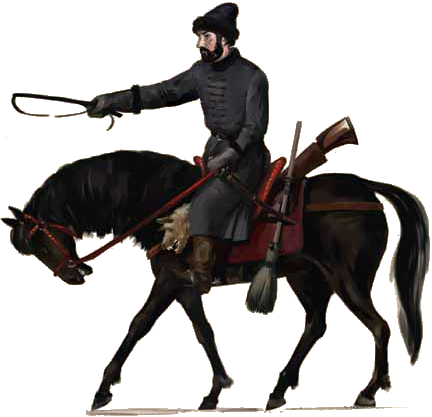

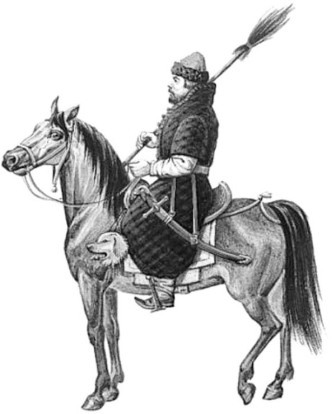

b) A Note on Names
Names can sometimes be confusing when reading this article -- this section is to clear up any misunderstanding, and ultimately help the reader better understand the information compiled in this article:
• Oprichnina - period of Russian history 1565-72 (often referencing specific land sectioned off by Tsar Ivan the Terrible)
• Select land had secret police, mass repressions, public executions, & confiscation of land from Russian aristocrats
• Oprichnik - an enforcer, protector, & police for Tsar Ivan IV; governing the oprichnina
• Oprichniki - plural form of Oprichnik (2+ Oprichnik are referred to as Oprichniki)
1) Name
• Russian police / police force
• (historically) The first Russian police force
• Oprichnik (op-reach-nick or op-rich-nick) or plural Oprichniki (op-reach-nick-ee or op-rich-nick-ee)
Collectively:
• (plural) Oprichniki -- multiple soldiers
• (nicknamed) Tsar’s Dogs
Members:
• (plural) Oprichniki
• (singular) Oprichnik
• (nicknamed) Tsar’s Dogs
* From obsolete oprich (Russian “apart from”, “except of”)
2) Background: Ivan IV
• 1553 Ivan near-fatally ill
• [date] wife Anastasia dies
• Suspects nobles poisoned her and
• Plot to remove him from throne
• Changed personality drastically
• Oppressed & killed many hereditary nobility
• 1564 secretly left Moscow
• Declared renouncing throne
• Population called for return in panic
• Held lengthy discussions
• Ivan agreed return
• Only on own terms:
• Absolute power
• Punish seemingly disloyal
3) Creation: The Oprichnina
• 1565 Ivan returned to Moscow
• System called Oprichnina (separate estate) established
• Active 1565-1572
• Select Russian territories/cities separated from the realm
• Zemschina - the area still continued under existing gov.
• Administered by Oprichnik [see below]
• Oprichniki became Ivan’s most loyal soldiers
• Oprichniki played central role in plan
• Elite group
Roles of Oprichniki:
• Precise role unclear
• Roles changed over time
• Few contemporary records exist
• Main objective: destroy opposition of Tsar
4) Outcome: Oprichniki as Reflection of Ivan
• Ivan becoming more erratic:
• Drunken feasts followed by frantic prayers & fasting in remote monasteries
• Alternated between savagery & piety
• Unpredictable
• Often sent monasteries great memorial payments & treasure
Fits of rage:
• Oprichnik kill mercilessly
• Uncontrollable cruelty
Bouts of religious humility:
• Oprichniki act as monks
• Established a religious order
5) Qualifications: Becoming Oprichniki
• Hand picked by Ivan
• Drawn mainly from lower military & societal levels
• [speculation] To avoid royalty/ upper class seeking Ivan’s power
• Each member questioned:
• Past was reviewed
• History of loyalty
• Devout to Ivan
• Numbers grew from 1000 to 6000 during Ivan’s reign
• Rewarded with land, property & payments
6) Appearance
• Dressed in all black
• Mostly Russian
• Included some foreigners
• [speculation] Likely male
• Cold, hardened faces
• [speculation] Arrogant/ deserving demeanor
• Because riches & land were handed to them
• Lead lives of luxuries
• Were above the law
7) Class: Roles of Oprichniki
• Precise role unclear
• Roles changed over time
• Few contemporary records
• [note] Little known about differences between classes
• [speculation]
Soldier:
Riders
• Rode black horses
Foot Soldiers
Monk:
Akin to modern militant Orthodox Christian chaplains
• During period of piety Tsar endowed new monastic order
• [speculation] Form of Orthodox Christianity
• Because Tsar claimed Christianity
• Drew brothers from the Oprichniki
• Oprichniki not corrupted church of sadistic monks
• Some accounts falsely claim this
• Power now interwoven in church & state
• Further blurred organisation's role
Bodyguards:
• [speculation] Always ready to react (quick reaction)
• Based on nature of their job
Nobility:
• New hand-picked nobility
• Replaced former boyars
• Because assassinations attempted of Tsar by former boyars
Police:
• Enforced Tsar’s laws & commands
Bureaucrats:
• Governed land
• Reigned with procedural correctness of Tsar
• Often at expense of people's needs
8) Items & Weaponry
Items:
• Rode black horses
• Carriages were black
• Wore dog head emblems
• (possibly--rarely) Carried severed dog’s heads
• Symbolic - sniffing out treason
• Biting/ nipping at enemy’s heels
• Wore broom emblems
• Carried brooms
• Symbolic - sweeping away Tsar’s enemies
Weapons:

• Sleeveless tunic of chain armor
• 2 halves (front & rear) iron buckles buttoned sides
• Large horizontal metallic plates fastened into chain armor netting
• Included spinal plates -- less & thinner
• Hem - forearm plate armor

• Dagger
• Blade - Steel or iron
• Wooden handles
• Curved blades
• Often hidden in right boot

• Broadsword
• Blade - Steel or iron
• Carried in velvet (sometimes animal skin) scabbards
• (if metal used) Scabbard made with iron

• Single-edged curved blade
• Blade - Steel or iron
• Typically slashing weapon
• Some [see picture] back near tip were extended & sharpened
• Allowed secondary, low quality thrusting capability
• [speculation] (rarely) Double edged blades
• Used for thrusting
• Scabbard hung from belt by 2 rings
• Carried in animal skin or velvet scabbards
• Made with/of iron
• Decorated with intricate gold or silver


• Knout (whip)
• Heavy scourge-like multiple whip
• Usually had many rawhide thongs attached to long handle
• Sometimes metal wire or hooks incorporated
Variations (lengths are approximate):
• Lash of rawhide 16 in long
• Attached to wooden handle 8.5-9 in long
• 3 lashes each attached by a metal ring
• End attached few inches of hard leather
• Ended in beak-like hook
• Many thongs of skin
• Skins braided with wire
• Ended in loose wired ends
• Like cat-o-nine tails
• Great Knout
• Handle 24 in long
• Flat leather thong twice handle length
• Middle had large copper or brass ring
• End affixed hide strip ending in point
• Point soaked in milk & dried - to harden

• Bardiches (long poleaxe) akin to halberd
• One of the shortest type of polearms
• Relied more on weight of heavy blade than swinging for damage
• Blade commonly 2ft long
• Shape varied greatly
• Most often long cleaver-type blade
• Attached with 1 or 2 sockets [picture has 2]
• Wooden shaft
• Rarely longer than 5ft
• Spear
• Pole weapon
• Thrusting (melee weapon) or throwing (called javelin)
• Wielded with either 1 or 2 hands
• Wooden shaft
• [speculation] Steel or iron head

• Bow of juniper or birch & tendons (6+ ft)
• Worn over left shoulder & on horses left
• Arrows of cane, reed, birch, apple-tree, or cypress
• Worn over right shoulder & placed on horses right
• Naluch' (bow case) & quiver often of skin
• Decorated with sewing
• Precious stones
• Velvet or brocade
• Arbalests (crossbow with winding crank)
• Inferior to bows firing power
• Greater impact
• Mostly rider weapon
• Bolt (small arrow shot from crossbow)
9) Oprichnik: Encounter
• Loyal to Tsar
• Answered only to Ivan & their commanders
• Executed anyone who displeased Ivan
• Top priority was kill traitors
• Could not be paid off
• Unstoppable
• Achieved motives despite overwhelming odds
• Violently took lands and riches
• Could kill whomever they wished
• Had free reign of Russia
• Stories & facts of exploits equally grotesque and outlandish as legends
• (mostly) Loose Christian beliefs
• When Tsar was present made Oprichniki perform Christian rituals
Methods of Killing:
• Did not act in pure orgy of bloodshed
• Everything done in calculating & cruel manner
• Often took prisoners & interrogated for leads
• Exploited others fear seeking info
• Impalement
• Mutilated
• Whipping
• Torture and rape was common
10) Mythology
• Oprichniki often described semi-mythically
• Image of black clothed investigators with unaccountable power effectively haunting
• Spread terror
• People even feared their name
• Feared saying Oprichnik
• Like dark omen summoning them
• Achieved motives despite overwhelming/ impossible odds
• [speculation] One reason why they were seen as demons or blessed by the devil(s)
• Created climate of fear & murder
• Cruel & brutal punishments created nightmarish mythology
• Enhanced by monastic connections
• [speculation] This bridged killings with religion & spirituality
• Killings seen as dark sacrifices
• Bloodthirsty
• Mindless, heartless killing machines
• Prince Kurbsky fled Muscovy 1564: “Children of darkness...hundreds and thousands of times worse than hangmen.”
11) History: Oprichnik in Action
• Lost influence of nobility
• People more compliant than ever
• Greatest killing 1570 massacre
• Wealthy city of Novgorod
• Its people suspected of treason
• Tsar believed planned to ally with Lithuania against him
• Ivan personally led Oprichniki
• City was ravaged
• Thousands murdered
• Used forged documents to hang, drown, or deport citizens
• Simultaneously destroying (burning) & plundering buildings & the countryside
• Estimated deaths vary between 15,000 and 60,000
12) The End of the Oprichnik
• Oprichniki began destroying itself
• Like most organizations ruling through terror
• Many internal quarrels & rivalries
• Oprichniki leaders began accusing each other of treason
• Zemschina (existing gov.) officials slowly replaced Oprichniki
• Many leading families attempted to join Oprichnina
• Sought protection through membership
• Oprichnina failed to defend country from Asianic groups
• Including Mongols, Turks, & modern Ukranians
• Ivan abolished group 1572
• Ivan tried reintegration of Oprichnina
• Created similar bodies throughout his life
• Constant gov. changes created internal chaos
• Skilled & peasant classes began leaving
• None became as notorious as the oprichnina
13) Influence
• Despite any benefits oprichnina will always be remembered as a time of terror.
• *Benefits: centralising political power, restructured wealth, etc.
• 1859 tragedy The Oprichnik (Russian: Опричники)
• Historical drama novel
• By respected playwright Ivan Lazhechnikov
• 1874 opera “The Oprichnik” or “The Guardsman”
• By Russian composer Pyotr Ilyich Tchaikovsky
• Set in Ivan’s court during the oprichnina times (1565–73)
• Based on Lazhechnikov’s The Oprichnik [see above]
• 1911 painting “Oprichnik”
• By Russian painter & graphic artist Apollinary Vasnetsov
• Specialized in scenes from Moscow medieval history
• Depicting city street & people fleeing in panic from the oprichniki
• 1922 - 1953 Joseph Stalin inspired by & praised the oprichnina
• Especially its role in damaging the boyar (upper class) aristocracy
• And enforcing central government
• 1954 - 1991 the KGB in Russia formed
• 'Original' Russian secret police
• Oprichnina was ancestor of KGB
• 2006 novel Day of the Oprichnik (Russian: День опричника, Den' oprichnika)
• By Russian writer Vladimir Sorokin
c) Sources:
“Prominent Russians: Ivan IV the Terrible” on russiapedia.rt.com by [link]
The European Dynastic States by Richard Bonney 1991
“The Oprichnina of Ivan IV - Part 1: The Creation of the Oprichnina” on europeanhistory.about.com by Robert Wilde 2001 [link]
“...Part 2: Terror and the Oprichniki” [link]
“...Part 3: The End of the Oprichnina” [link]
Ivan the Terrible: First Tsar of Russia by Isabel De Madariaga 2005
Tchaikovsky: The Man and his Music by David Brown 2010
Apollinary Vasnetsov by Yekateri Vasnetsova 1980
“Knout” on wikipedia [link]
“Medieval Weapons and Armour: Bardiches” on medievalwarfare.info [link]
“Russian Armors X-XVII Centuries: The Missile Weapon” on cross-dream.info [link]
“Russian Armors X-XVII Centuries: Swords and the Sabre” on cross-dream.info [link]
“Russian Armors X-XVII Centuries: Kolontar’ XIV Century” on cross-dream.info [link]
